Where students sit can affect how they see the board, interact with classmates, follow instructions, and move around the room. But there is no classroom seating arrangement that works perfectly for every teacher, student, or lesson.
Ready to try a seating plan as you read? Open the Sabura Teacher Dashboard, choose Seats from More, and explore rows, group clusters, or a U-shape with your student list.
Open Teacher DashboardTraditional rows can be useful for focused independent work. Group clusters create opportunities for collaboration. A U-shaped layout can make discussions feel more connected. Even small changes—such as moving a desk to improve visibility or creating a wider walkway—can make a classroom easier to use.
This guide compares popular classroom seating layouts, explains what to encourage and what to avoid, and walks through creating a seating plan that can change as your students' needs change.
Why does classroom seating matter?
Classroom seating is part of the learning environment, not just a furniture decision. A thoughtful layout can support:
- Attention: Students can see the teaching area and have fewer avoidable distractions.
- Participation: Students have opportunities to contribute, listen, and respond.
- Collaboration: Partners and teams can share materials and exchange ideas.
- Classroom routines: Teachers and students can move through the room safely and predictably.
- Inclusion: The arrangement can accommodate differences in vision, hearing, mobility, comfort, and learning needs.
A good seating plan balances these goals. A layout that makes discussion easy may not be ideal for a quiet assessment. The key is matching the arrangement to what students will actually be doing.
Five classroom seating arrangements to consider
1. Traditional rows and columns
Desks face the teaching area in straight rows and columns. This familiar setup provides a predictable structure and usually makes it easy for students to focus on a board or presentation.
Best for: Direct instruction, independent writing, tests, and tasks that require sustained individual attention.
Advantages:
- Clear orientation toward the front of the classroom.
- Often easier to monitor independent work.
- Can reduce face-to-face conversations during quiet tasks.
- Simple to organize in rooms with fixed furniture.
Limitations:
- Students have fewer natural opportunities for group discussion.
- Some seats may be far from the teacher or have awkward sightlines.
- Collaborative work can require turning chairs or rearranging desks.
Teacher tip: Check the view from the back and outer edges, not just from the teacher's desk. Leave usable walkways between rows.
- Oliver
- Jack
- Harry
- Noah
- James
- Henry
- Leo
- Lucas
- Thomas
- Arthur
- Albie
- Freddie
- Olivia
- Amelia
- Isla
- Lily
- Ava
- Ivy
- Freya
- Florence
- Mia
- Charlotte
- Grace
- Poppy
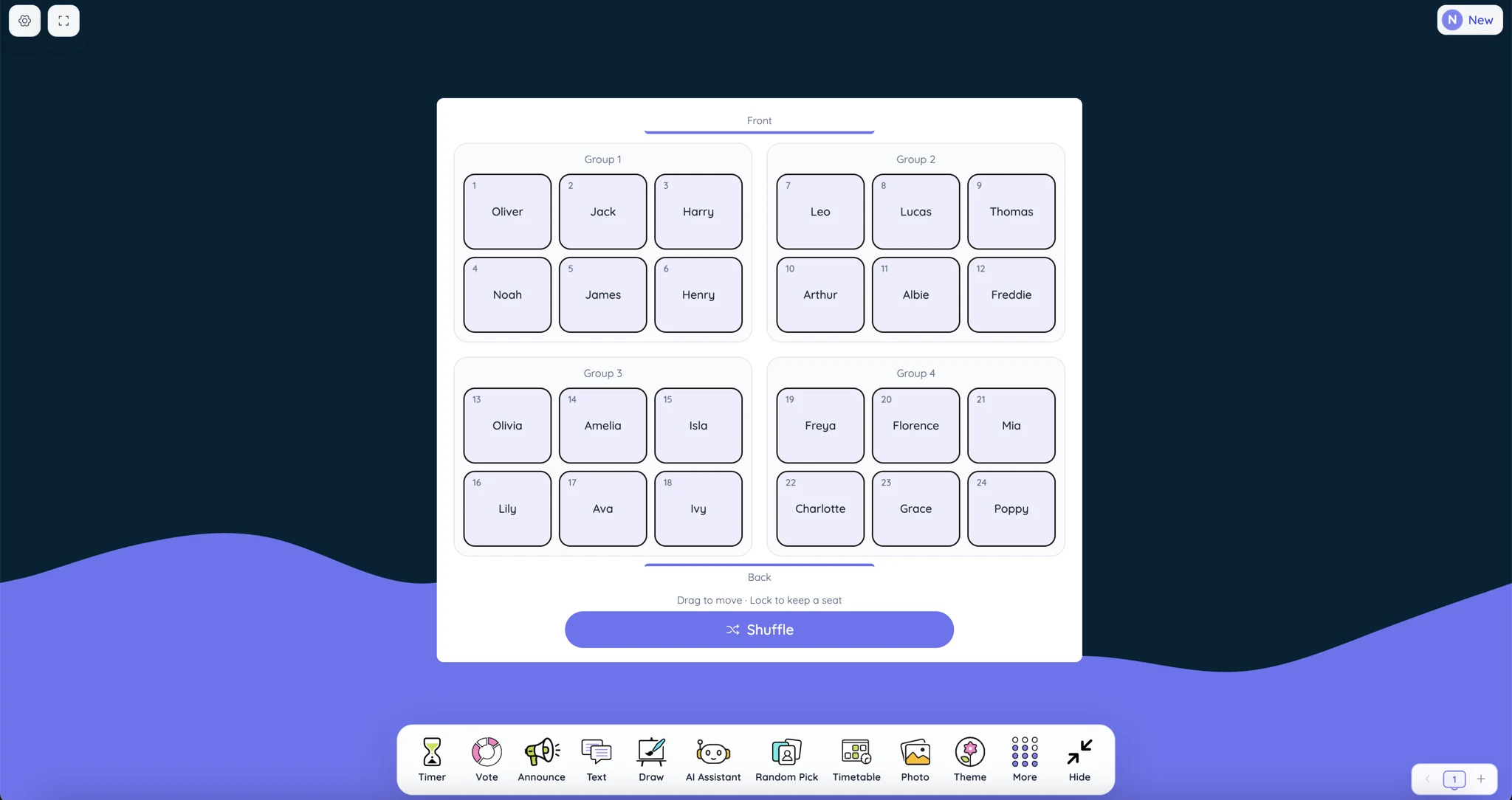
2. Group clusters
Desks are gathered into small islands, often with four students per group. Other group sizes can work, depending on the activity and room size.
Best for: Project work, problem-solving, shared writing, hands-on activities, and cooperative learning.
Advantages:
- Students can talk and exchange materials without moving furniture.
- Group roles are easier to organize.
- Teachers can move between teams to support their work.
Limitations:
- Conversations may continue during independent tasks.
- Some students may sit sideways or with their backs to the board.
- One student may dominate while others participate less.
Teacher tip: Don't rely on the furniture alone to create teamwork. Give students a clear goal, a time limit, and responsibilities such as facilitator, recorder, or presenter. Check that everyone can turn to view the board when necessary.
- Oliver
- Jack
- Harry
- Noah
- James
- Henry
- Leo
- Lucas
- Thomas
- Arthur
- Albie
- Freddie
- Olivia
- Amelia
- Isla
- Lily
- Ava
- Ivy
- Freya
- Florence
- Mia
- Charlotte
- Grace
- Poppy
3. U-shaped or horseshoe seating
Desks form three sides of a U, leaving an open space in the middle. This arrangement can help students see one another during a whole-class conversation.
Best for: Debates, seminars, speaking activities, demonstrations, and class discussions.
Advantages:
- Supports eye contact and whole-class dialogue.
- Creates a central space for a demonstration or presentation.
- Makes it easier to address classmates rather than only the teacher.
Limitations:
- Uses significant floor space and can be difficult in a large class.
- Students at the sides may need to turn to see a screen or board.
- It may be inefficient for frequent small-group activities.
Teacher tip: Measure the real classroom before planning a U-shape. Keep the opening and exits clear, and make sure the arrangement does not create long, crowded routes around the desks.
- Oliver
- Jack
- Harry
- Noah
- James
- Henry
- Leo
- Lucas
- Thomas
- Arthur
- Albie
- Freddie
- Olivia
- Amelia
4. Paired seating
Students sit two by two, usually facing the front. Pairs can offer a compromise between individual focus and quick interaction.
Best for: Think-pair-share, reading partners, peer feedback, and short collaborative tasks.
Advantages:
- Partners can discuss questions without changing the entire layout.
- The class can still face forward for instruction.
- Teachers can adjust partnerships with relatively little disruption.
Limitations:
- An unproductive pairing may lead to distraction.
- Partners may participate unequally.
- It is less suitable for projects requiring larger teams.
Teacher tip: Review pairs based on how students work together, not only on who is friends with whom. Rotate partners when there is a clear reason, rather than moving students constantly.
5. Flexible or hybrid arrangements
Some classrooms combine different zones: desks for focused work, grouped tables for projects, and a shared discussion area. Other classrooms switch arrangements across the day.
Best for: Lessons that alternate between individual work, collaboration, and discussion—when the room, furniture, and routines allow it.
Advantages:
- Lets the layout respond to the lesson rather than forcing every activity into one format.
- Can offer students meaningful choices about how they work.
- Creates space for different activities and support needs.
Limitations:
- Furniture changes cost time and may create noise.
- Choice without clear expectations can become distracting.
- Some rooms cannot accommodate multiple zones safely.
Teacher tip: Start with one manageable change. Establish a routine for moving furniture and returning it to place before introducing more flexibility.
Which arrangement should you choose?
Use this quick guide as a starting point:
- Mostly independent work? Start with rows or pairs.
- Team-based projects? Consider small group clusters.
- Debate or whole-class discussion? Try a U-shape when there is enough space.
- A mixture of activities? Consider a hybrid arrangement or change the layout for specific lessons.
- Limited space or fixed desks? Prioritize sightlines, pathways, and practical adjustments over an elaborate layout.
These are not universal rules. The same students may work well in clusters for a science investigation and need a quieter arrangement for a written assessment.
What does research say about seating arrangements?
A 2008 research review by Rachel Wannarka and Kathy Ruhl examined eight studies comparing classroom seating configurations. It reported that rows tended to support more appropriate behavior during individual tasks, particularly for students who were more easily distracted. Its broader conclusion was that seating should be chosen according to the task—not treated as a one-size-fits-all solution.
A 2016 study by Mariola Gremmen and colleagues investigated how 50 primary-school teachers thought about classroom seating. Teachers reported considering academic, social, physical, and classroom-management factors, with small groups often preferred when promoting cooperation was the goal.
These studies do not mean that rows are always better than clusters, or that a U-shape guarantees greater participation. They suggest something more useful: choose deliberately, observe what happens, and revise the plan when needed.
Research references are listed at the end of this article.
Seven classroom seating best practices
1. Start with the learning goal
Ask what students need to do most during the lesson. Watching a demonstration, solving a problem as a team, and completing a quiet test place different demands on the room. Choose the seating arrangement only after identifying the activity.
2. Protect sightlines and hearing
Sit in different seats and check whether students can comfortably see the board, projector, and demonstration area. Consider who needs to hear instructions clearly and whether any desk requires an awkward viewing angle.
3. Make accessibility non-negotiable
Keep entrances, exits, and walkways accessible. Account for mobility aids, assistive technology, and relevant student accommodations. Do not assume that the arrangement that looks most symmetrical is the most inclusive.
4. Plan for safe movement
Teachers should be able to reach students without squeezing between desks. Students should be able to access materials and leave their seats without creating bottlenecks. In group clusters and U-shaped rooms, check the corners and central pathways carefully.
5. Encourage productive interaction
Create opportunities for students to hear different perspectives, but provide clear discussion norms. In groups, assign responsibilities and rotate opportunities to speak. Do not leave quieter students to compete for a turn.
6. Include student input without giving up structure
A quick, private question—“Is anything about your seat making it difficult to learn?”—can reveal issues that are invisible from the front of the room. Consider preferences alongside classroom needs, not as the only factor.
7. Review the plan after real lessons
Look for practical signs: Can students see? Are discussions balanced? Are transitions smooth? Is independent work focused? Change the seats when there is a reason, rather than following an arbitrary weekly or monthly schedule.
Seven common seating mistakes to avoid
- Choosing a layout because it looks attractive. A symmetrical plan may still block the board or leave narrow aisles. Test function before appearance.
- Forgetting individual needs. Check accessibility, sensory needs, and reasonable accommodations from the start, not after students complain.
- Putting friends together—or separating them—automatically. Observe how particular combinations work for the task and avoid assumptions.
- Using seating as public punishment. If a change is necessary, explain it respectfully and privately where possible.
- Expecting clusters to create teamwork on their own. Collaboration needs instructions, roles, and accountability.
- Changing everyone's seat too often. Predictability can help students settle into routines; change the layout for a clear benefit.
- Making a chart without checking the real room. A digital diagram cannot reveal every blocked view, tight corner, or awkward desk placement.
Assigned seating or student choice?
Assigned seating helps teachers plan visibility, partnerships, and support. Student choice can offer autonomy and may help students find a comfortable place to work. Neither approach is automatically best.
A practical middle ground is to assign seats during regular instruction while allowing limited choice for suitable activities. Another option is to offer students a few acceptable places to choose from. Explain the rules, listen to reasonable concerns, and monitor whether the arrangement is working.
Avoid using student choice in a way that leaves anyone isolated, repeatedly excluded, or unable to access the lesson.
When should teachers change the seating plan?
Review the plan when the lesson format changes, a new student joins, students struggle to concentrate, accessibility needs change, or group dynamics create difficulties. A seating change can also be useful before a sustained collaborative project or assessment period.
But change is not automatically improvement. If the layout supports learning and students are comfortable, there is no need to rearrange it simply because another week has passed.
How to make a classroom seating chart in six steps
- List the students. Check the class size and whether some seats need to remain available or unassigned.
- Sketch the real room. Mark the board, doors, walkways, fixed furniture, and any areas that must remain clear.
- Pick a suitable layout. Choose rows, pairs, clusters, or a U-shape based on the learning task and the available space.
- Consider student needs. Review visibility, accessibility, concentration, and working relationships without making assumptions about students.
- Assign and review seats. Look for crowding, blocked views, and difficult groupings before moving furniture.
- Try it and adjust. Make small changes based on what you observe in real lessons.
The chart should remain easy to update. A seating plan is a working classroom-management tool, not a permanent judgment about where a student belongs.
Plan student seats with Sabura
If you often adjust your classroom seating chart, a digital tool can help you prepare before students enter the room.
Sabura's seating tool lets teachers enter student names or use a saved list and choose a layout: traditional rows and columns, group clusters, or a U-shape. Teachers can build a visual seating plan, move students to empty seats, and swap two students' positions. They can also lock seats they want to preserve and shuffle the remaining assignments. This makes it easier to compare practical seating options before moving physical desks.
For example, a teacher preparing a group project can select group clusters; before a class discussion, the teacher can try a U-shaped chart. Start with your student list, create the plan, then review the real classroom for visibility, safe movement, and individual needs. A digital chart is a planning aid—not a substitute for that final check.
Explore Sabura's classroom seating tool: Explore the Seats tool
Frequently asked questions
What is the best seating arrangement for a classroom?
The best arrangement depends on the task and your students. Rows can support quiet individual work, clusters support collaboration, and a U-shape can be useful for whole-class discussion.
Are group clusters better than rows?
Not in every situation. Clusters make interaction easier, but they can introduce distractions. Rows may be more effective for some independent tasks. Use the arrangement that matches the learning objective.
How many students should sit in a cluster?
Four is a practical starting point in many classrooms, but groups of three to six can also work. Consider task complexity, available space, and whether everyone will have a meaningful role.
Does U-shaped seating work for large classes?
It can be difficult in a large or narrow room because it takes floor space. Check how many desks fit, whether the board remains visible, and whether students can move safely.
Should students choose their own seats?
Student input is valuable, but assigned seats can help with visibility, support, and group dynamics. Many teachers use a combination of assigned seating and limited choice.
How often should I change classroom seats?
There is no fixed interval. Adjust when a change would improve learning, access, behavior, or classroom routines; otherwise, stability can be helpful.
Can I create a seating chart online?
Yes. A digital seating chart can help you assign names, review positions, and make changes before rearranging the actual room. Sabura includes a seating tool with rows/columns, group clusters, and U-shaped layout options for this purpose.
Final thoughts
Classroom seating should serve learning—not the other way around. Rows, pairs, group clusters, and U-shaped layouts each have strengths. Consider the activity, prioritize access and visibility, involve students appropriately, and be ready to refine the plan.
The most useful seating chart is not the one that looks perfect on the screen. It is the one that works for real students in a real classroom.
Sources and further reading
Wannarka, R., & Ruhl, K. (2008). Seating arrangements that promote positive academic and behavioural outcomes: A review of empirical research. Support for Learning, 23(2), 89–93. https://doi.org/10.1111/j.1467-9604.2008.00375.x
Gremmen, M. C., van den Berg, Y. H. M., Segers, E., & Cillessen, A. H. N. (2016). Considerations for classroom seating arrangements and the role of teacher characteristics and beliefs. Social Psychology of Education, 19, 749–774. https://doi.org/10.1007/s11218-016-9353-y